
 MainStreet Fall Protection proudly provides our valued clients with products and services, as well as education on safety regulations and standards of the Occupational Safety & Health Administration (OSHA).
FALL HAZARD ANALYSIS:
OSHA requires that “fall protection be provided at elevations of four feet in general industry workplaces”. Employers are responsible for taking the initiative to implement a job hazard analysis for your workplace to ensure the safety of your workers.
ANCHOR INSPECTION:
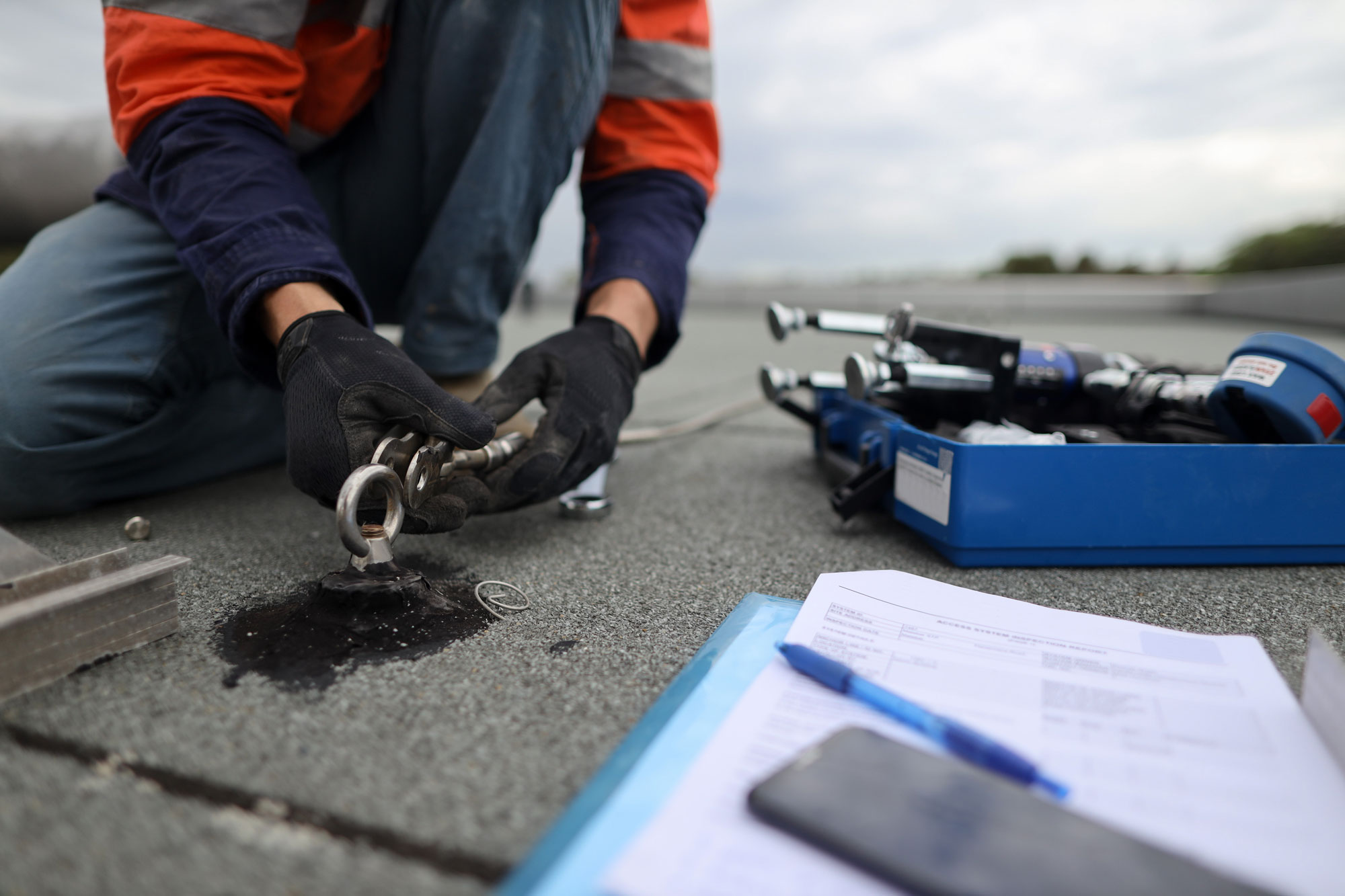
MainStreet Fall Protection has the experience and expertise you need to perform OSHA and ANSI-mandated inspections to help you keep your fall protection system compliant. Product inspection and safety go hand in hand. Regular ongoing inspections are a life-saving necessity and REQUIRED by OSHA.
OSHA states that your fall protection anchorage system MUST be inspected annually by a qualified person.
All industry safety standards are followed by MainStreet Fall Protection, properly performing, and documenting ALL inspections to ensure that current and future users of fall protection equipment comply with applicable safety standards.
ANCHOR CERTIFICATION:
Fall protection systems and equipment certification.
All components are inspected and certified after completing the installation of any fall arrest system as well as fall protection equipment. Our Certification documents that your fall protection system and all related personal protection equipment (PPE) comply with OSHA regulations. Proper signage validates the tested capabilities and operational limits of the system and tells outside inspectors that the system has been tested by an OSHA-approved “qualified person”.
OSHA requires at minimum, an annual inspection must be performed by a “qualified person” and re-certified after 10 years.
ANCHOR RE-CERTIFICATION:
MainStreet Fall Protection’s licensed professionals are fully conversant with the guidelines, procedures and documentation required for the re-certification of varying fall protection systems.
1910.66(g)
Inspection and tests-
1910.66(g)(1)
Installations and alterations. All completed building maintenance equipment installations shall be inspected and tested in the field before being placed in initial service to determine that all parts of the installation conform to applicable requirements of this standard, and that all safety and operating equipment is functioning as required. A similar inspection and test shall be made following any major alteration to an existing installation. No hoist in an installation shall be subjected to a load in excess of 125 percent of its rated load.
1910.66(g)(2)
Periodic inspections and tests.
1910.66(g)(2)(i)
Related building supporting structures shall undergo periodic inspection by a competent person at intervals not exceeding 12 months.
1910.66(g)(2)(ii)
All parts of the equipment including control systems shall be inspected, and, where necessary, tested by a competent person at intervals specified by the manufacturer/supplier, but not to exceed 12 months, to determine that they are in safe operating condition. Parts subject to wear, such as wire ropes, bearings, gears, and governors shall be inspected and/or tested to determine that they have not worn to such an extent as to affect the safe operation of the installation.
1910.66(g)(2)(iii)
The building owner shall keep a certification record of each inspection and test required under paragraphs (g)(2)(i) and (ii) of this section. The certification record shall include the date of the inspection, the signature of the person who performed the inspection, and the number, or other identifier, of the building support structure and equipment which was inspected. This certification record shall be kept readily available for review by the Assistant Secretary of Labor or the Assistant Secretary’s representative and by the employer.
1910.66(g)(2)(iv)
Working platforms and their components shall be inspected by the employer for visible defects before every use and after each occurrence which could affect the platform’s structural integrity.
ANCHOR LOAD PULL TEST:
The strength and durability of eye bolts, anchor bolts, scaffold ties, stud anchors, resin bolts and safety wires can be affected by many factors, so it is essential to regularly check, inspect and test load pulls. This is particularly useful when visual inspection is just not enough.
Anchor pull testing services done by MainStreet Fall Protection will provide you with all the answers and help that you need to determine the next course of action. Our pull tests are performed to determine the strength of fixtures installed or fitted into walls & roofs and are vital for commercial buildings, railways and airports.
Our highly skilled and professional team uses their extensive knowledge and top of the line equipment to provide you with the most accurate anchor load pull testing and expertise to give you peace of mind and a safe workplace.
Certified engineers will accompany all qualified persons with the pull tests.
Anchor load pull testing services we offer:
- Anchor Load Pull Out Testing & Tensile Strength
- Shear Testing
- Surface Bond Testing
- Bolt / Anchor Bolt Testing
- Erection / Eye / Rawl Bolts
- Safety Wire Testing
- Stud Anchors & Resin Bolts
- Scaffold Ties
- Tension Testing
- Holding Down Bolts
How are pull tests performed?
We use state of the art equipment for our pull-out testing. It attaches to the outside bolt, nut, screw or fixing. We then pull to the designated stress load level per provided blueprint drawings to establish how strong and secure the fixing is. Although materials used for bonding may vary, this method remains the same for all types of fixing.